Car nomenclature
Until 1994, Mercedes-Benz used an alphanumeric system for categorising their vehicles, consisting of a number sequence approximately equal to the motor's displacement in liters multiplied by 100, followed by an arrangement of alphabetical suffixes indicating body style and motor type.
"C" indicates a coupe or cabriolet body style.
"D" means the vehicle is equipped with a diesel motor.
"E" (for "Einspritzen") means the vehicle's engine is equipped with petrol fuel injection. In most cases (the 600 limousine being the exception), if neither "E" or "D" is present, the vehicle has a petrol motor with a carburettor.
"G" denotes the Gelandewagen off-road vehicle.
"K" was used in the 1930s, indicating a supercharger ("Kompressor") equipped engine. One exception is the SSK, where K indicates "Kurz" (short-wheelbase).
"L" means "Leicht" (lightweight) for sporting models, and "Lang" (long-wheelbase) for sedan models.
"R" stands for "Rennen" (racing), used for racing cars (for example, the 300SLR).
"S" means "Sport" for high-performance models or "Special" for flagship models.
"T" stands for "Touring" and indicates an estate (or station wagon) body style.
Some models in the 1950s also had lower-case letters (b, c, and d) to indicate specific trim levels.
For some models, the numeric part of the designation does not match the motor displacement. This was done to show the model's position in the model lineup independent of displacement or in the price matrix. For these vehicles, the actual displacement in liters is suffixed to the model designation. For example, the 190-class all had "190" for the numeric designation, regardless of the motor size, to indicate their entry-level status. Also, some older models (such as the SS and SSK) did not have a number as part of the designation at all.
For the 1994 model year, Mercedes-Benz revised the naming system. Models were divided into "classes" denoted by an arrangement of up to three letters (see "Current model range" above), followed by a three-digit (or two-digit for AMG models, with the number approximately equal to the displacement in liters multiplied by 10) number related to the engine size, as before. Variants of the same model (such as an estate version, or a vehicle with a diesel engine) are no longer given a separate letter. In most cases, the class designation is arbitrary. The SLR and SLS supercars do not carry a numerical designation.
As before, some models' numerical designations do not match the motor's actual displacement; in these cases the number shows the model's relative performance within the class. For example, the E250 CGI has greater performance than the E200 CGI because of different engine tuning, even though both have 1.8-litre motors. Recent AMG models use the "63" designation (in honor of the 1960s 6.3-litre M100 motor) despite being equipped with either a 6.2-litre (M156) or 5.5-litre (M157) motor.
Some models carry further designations indicating special features:
"4MATIC" means the vehicle is equipped with all-wheel-drive.
"BlueTEC" indicates a diesel motor with selective catalytic reduction exhaust aftertreatment.
"BlueEFFICIENCY" indicates special fuel economy features (direct injection, start-stop system, aerodynamic modifications, etc.)
"CGI" (Charged Gasoline Injection) indicates direct gasoline injection.
"CDI" (Common-rail Direct Injection) indicates a common-rail diesel motor.
"Hybrid" indicates a gasoline- or diesel-electric hybrid.
"NGT" indicates a natural gas-fueled motor.
"Kompressor" indicates a supercharged motor.
"Turbo" indicates a turbocharged motor, only used on A-, B-,Е- and GLK-Class models.
All model designation badges can be deleted upon the customer's request.
_Classic_hatchback_01.jpg)
_Classic_sedan_03.jpg)


 GLK-Class - Sports Utility Vehicle (SUV)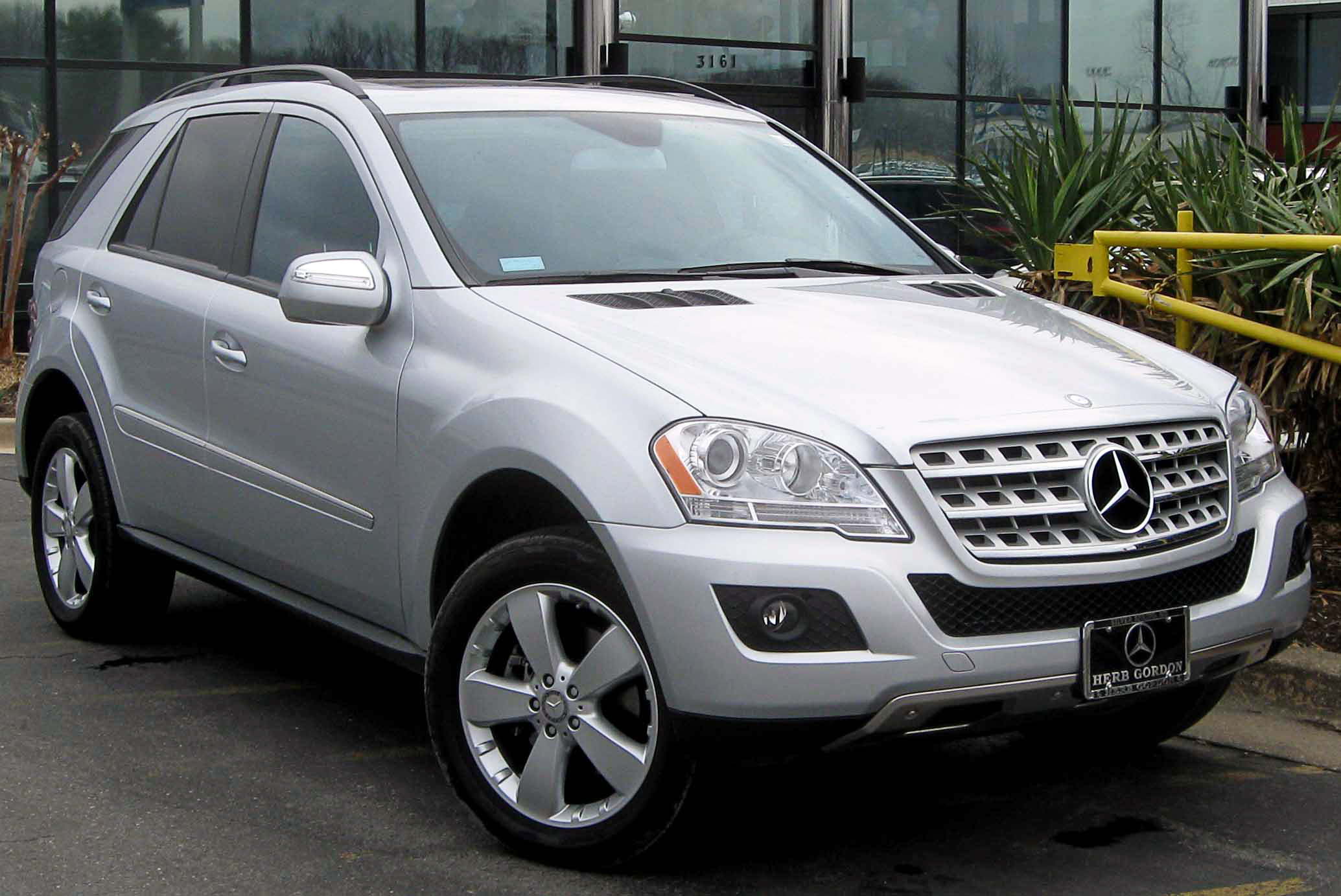
_Facelift_front-1_20101017.jpg)

_%E2%80%93_Frontansicht,_11._M%C3%A4rz_2011,_Teneriffa.jpg)
_&_Mercedes-Benz_300_SL_(W_198)_%E2%80%93_Frontansicht,_10._August_2011,_D%C3%BCsseldorf.jpg)